What began in 1946 as a small service operation in Portland, Oregon; a team with deep hands-on knowledge of why pumps fail and the parts inventory to fix them, has grown into one of the most trusted names in centrifugal pump manufacturing in the world. Today, Cornell Pump Company marks its 80th anniversary, and we’re celebrating not just what we’ve built, but the farms irrigated, the disasters answered, the industries fed, and the problems solved along the way.
As we kick off a year-long celebration of our 80th anniversary, we invite you to look back at the milestones that shaped us from a small independent service shop into a global leader in centrifugal pump technology.
The Foundation: 1946–1959
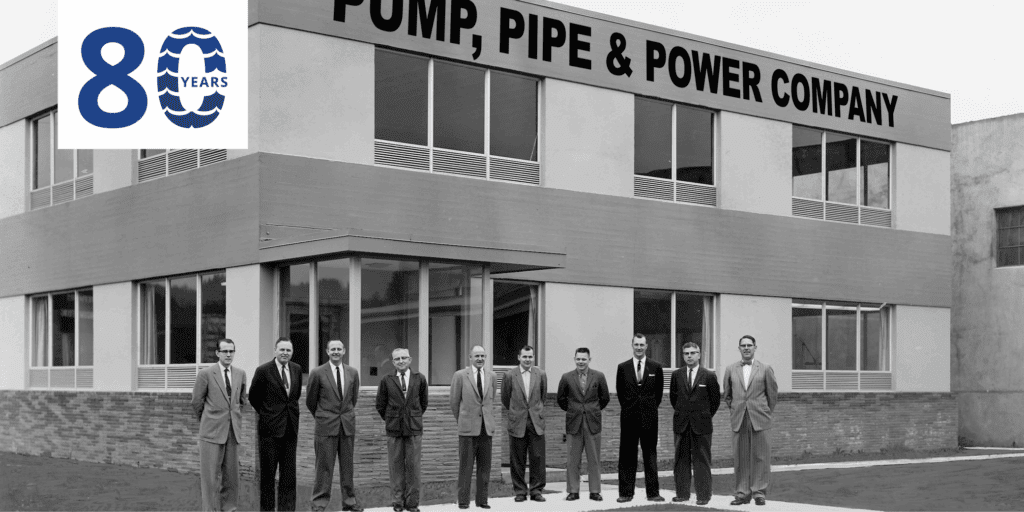
The Cornell story began on May 1, 1946, when five forward-thinking employees from the Pacific Pump Company decided to strike out on their own. Operating initially as a service department, the founders had a front-row seat to the most common causes of pump failure: pressure surges, motor bearing breakdowns, and capacity overloads.
By 1949, we transitioned from servicing others’ equipment to manufacturing our own, launching the “Rain-O-Flow” irrigation line. This period also saw the birth of Cornell Pump School, which started as traveling lectures to help operators understand hydraulics; a tradition of education that remains a cornerstone of our company today.
Building Modern Infrastructure: The 1960s & 70s
As the world grew, so did Cornell. We became a trusted name in heavy construction, providing massive pumps for the building of bridges and dams. One of our most unique early innovations came during dam production: concrete would often become too hot and weaken while setting. Cornell engineers adapted water pumps to circulate liquid ammonia to cool the concrete, a breakthrough that eventually led to our expansion into industrial refrigeration.
In 1964, we revolutionized the food industry with the Hydro-Transport series. Featuring a single-port impeller and a unique offset volute, this pump allowed for the safe transport of delicate foods like tomatoes, potatoes, and even live fish, boasting the lowest damage rate in the industry.
Global Expansion & Refined Reliability: The 1980s–2000s
By the 1980s, our food-handling expertise expanded into hot oil transportation. Our pumps became the standard for major global brands, powering the fryers that produce some of the world’s most recognizable French fries and snacks.
The turn of the century brought new technical challenges and opportunities for service. In 2001, Cornell pumps played a critical role in the dewatering efforts at Ground Zero in New York City. Throughout this era, we perfected the features that now define the “Cornell Advantage,” including Cycloseal®, Redi-Prime®, and Run-Dry™ technologies, ensuring our pumps could handle the toughest environments on earth.
The Modern Era: 2010–Present
The last decade has seen a rapid acceleration in our technological capabilities and our commitment to system-wide integration. We’ve evolved from being a premier equipment manufacturer to a provider of intelligent, integrated systems that solve the world’s most complex fluid-handling challenges.
- Pioneering the Industrial Digital Transformation: Cornell has moved beyond the pump itself to the data behind it. With the launch of Co-Pilot®, Pulse®, and RPM2®, we have led the charge in IoT (Internet of Things) innovations. These tools allow operators to monitor pump health, location, and performance in real-time, preventing downtime before it happens—a far cry from the manual monitoring of 1946.
- The Waste Warrior Revolution: In response to the growing global challenge of “unflushables” and heavy solids in wastewater, we introduced the Waste Warrior ® cutter pump. This innovation ensures that municipal and industrial waste systems stay clear, further cementing our reputation for solving the industry’s “messiest” problems.
- Pushing Extreme Performance with the MX Series: We continue to redefine the physical limits of centrifugal design. Our MX lines represent the pinnacle of high-head technology, achieving heads of up to 825 feet (251 meters). These pumps are designed specifically for the most demanding dewatering and high-pressure applications where standard pumps simply can’t compete.
- Mining the Hardest Materials: The introduction of the SM and MP Hard Metal lines brought Cornell’s signature reliability to the mining and slurry industries. Built with high-chrome white iron, these pumps are engineered to withstand the abrasive environments that would chew through standard equipment.
- Refining Industrial Standards with the Z-Series and Arctic King: We’ve taken established concepts and perfected them. The Z-Series ANSI pumps brought Cornell’s efficiency to a standardized footprint, while the Arctic King series expanded our dominance in industrial refrigeration, offering a hermetic solution for ammonia and glycol applications.
- Squeezing Every Drop of Efficiency with the STX Line: True to the Cornell legacy of performance, the STX self-priming line was engineered to offer superior efficiency in a category where performance is often sacrificed for convenience. It remains a testament to our belief that a pump should not only work , it should work better than anything else on the market.
As we look toward the next 80 years, our focus remains on the same principles that guided those five founders in 1946: reliability, innovation, and a relentless drive to solve the industry’s hardest problems. That hands-on problem-solving mindset became the foundation of everything we do. Instead of just fixing pumps, we set out to build better ones.
Explore our full history at cornellpump.com/cornell-history and follow along as we mark this milestone throughout the next 12 months.